AGENT·EMILYB

Emily by Co-Desk
co-desk.eu
Voice AI copilot for coworking & coliving operators
AI Agentnofollowproduct_hunt
 MCP Hub
Manage AI agents, tasks, workspaces from one control layer
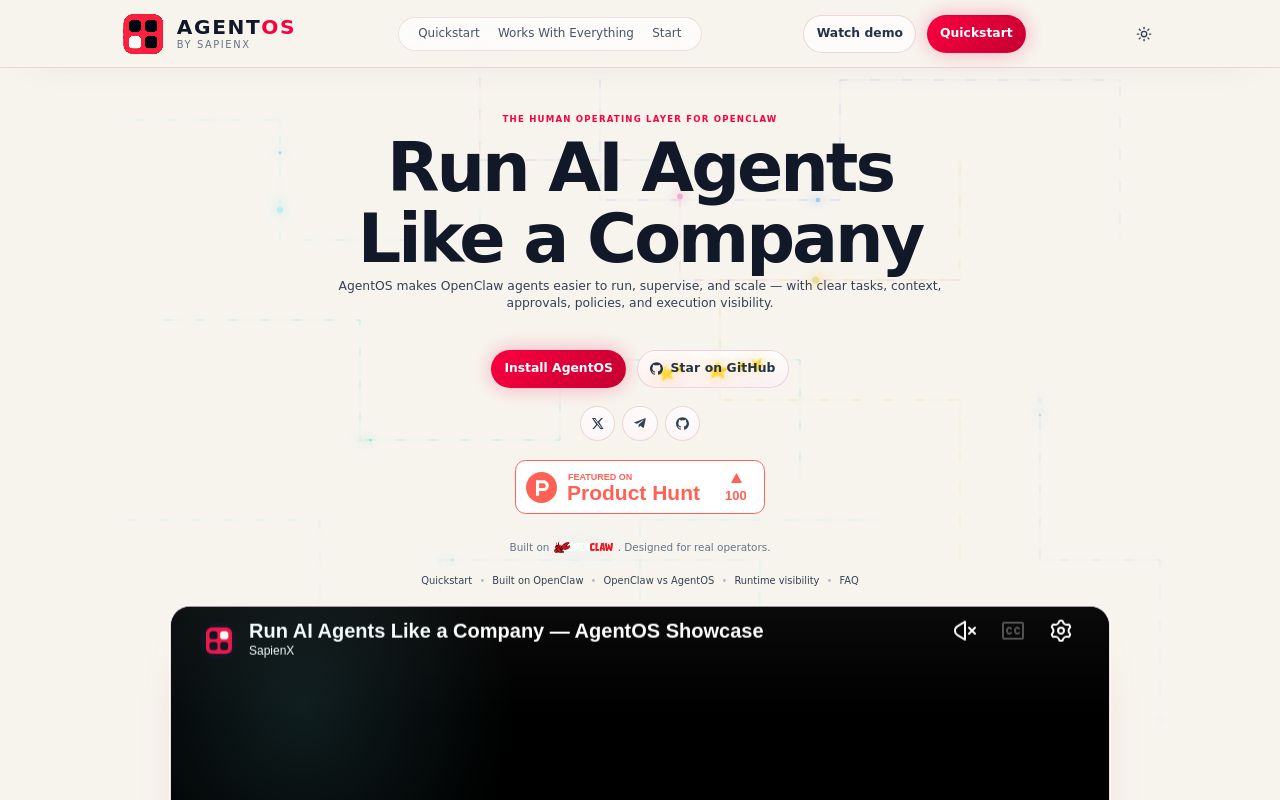
AgentOS is an open-source platform designed to streamline the management of AI agents, tasks, and workspaces through a unified control layer. Featured on Product Hunt with 100+ votes, it offers developers and teams a structured way to orchestrate AI workflows. With a domain rating of 9 and 90 backlinks, AgentOS is gaining traction in productivity and AI automation spaces.
This article explores AgentOS’s commercial viability, core functionality, use cases, evaluation criteria, alternatives, and frequently asked questions—all grounded in verifiable data.
AgentOS demonstrates moderate commercial intent (score: 30) based on measurable indicators:
- Domain Authority: A domain rating of 9 suggests foundational credibility.
- Backlinks: 90 backlinks indicate organic interest, though direct monetization isn’t confirmed.
- Product Hunt Engagement: 100+ votes and 6 comments reflect early adopter validation.
- Google Trends: Stable search interest aligns with broader AI automation trends.
While the website (sapienx.app/agentos/) doesn’t disclose pricing or paid plans, its GitHub presence and open-source model suggest a focus on community-driven growth. The platform may monetize through enterprise features or support services in the future.
For users evaluating commercial viability, AgentOS is best suited for developers seeking extensible AI orchestration tools without vendor lock-in.
AgentOS provides a centralized interface to:
- Manage AI Agents: Deploy, monitor, and scale autonomous agents from a single dashboard.
- Task Automation: Create and assign tasks across agents, with progress tracking.
- Workspace Coordination: Organize projects into workspaces for team collaboration.
Key technical features (per Product Hunt and GitHub):
- Open-Source Foundation: Customizable via GitHub, appealing to developers.
- Unified Control Layer: Reduces fragmentation when working with multiple agents.
- API Integrations: Likely supports third-party tools, though specifics aren’t listed.
Unlike proprietary solutions, AgentOS emphasizes transparency and user control, making it ideal for those who prioritize flexibility over out-of-the-box polish.
Teams building AI-powered apps can use AgentOS to manage testing agents, automate code reviews, or handle CI/CD tasks.
Academic or R&D teams can orchestrate data-scraping agents, simulation environments, and analysis workflows.
Though not confirmed for enterprise use, the platform’s workspace model could help departments coordinate AI-driven HR, IT, or customer support tasks.
Communities maintaining AI tools can leverage AgentOS for contributor task delegation and version control integration.
AgentOS’s lack of confirmed enterprise integrations may limit scalability for large organizations, but its open-source nature allows for customization.
When assessing AgentOS, consider:
- Pros: Open-source code enables deep customization.
- Cons: May require technical expertise to deploy effectively.
- Backlink and GitHub activity suggest growing adoption, but unclear if it supports high-throughput workloads.
- 6 Product Hunt comments and GitHub issues (if any) indicate nascent but active discussion.
- Free tier likely exists (as an open-source tool), but premium features aren’t documented.
- Self-hosted options may aid data governance, but compliance certifications aren’t mentioned.
- Pros: Strong model integration, established community.
- Cons: Less focus on task orchestration.
- Pros: Framework for chaining AI tasks.
- Cons: Requires more manual setup than a centralized dashboard.
- Pros: Enterprise support, polished UI.
- Cons: Vendor lock-in, less transparent.
AgentOS competes best for users prioritizing open-source control over turnkey solutions.
Yes, as an open-source project, core features are likely free. Future premium tiers aren’t confirmed.
AgentOS focuses on AI agent management, while Zapier/Make target general workflow automation.
Probable, given its GitHub presence, but documentation should be verified.
Unconfirmed, but open-source design suggests compatibility via APIs.
nofollow attributes for outbound links.
AgentOS fills a niche for developers needing structured AI agent management without proprietary constraints. Its trajectory depends on community adoption and potential monetization strategies. For updates, monitor Product Hunt or GitHub.
co-desk.eu
Voice AI copilot for coworking & coliving operators

socialecho.net
AI social media copilot for teams and agents

perplexity.ai
Run AI agents across your local files and apps on Windows